


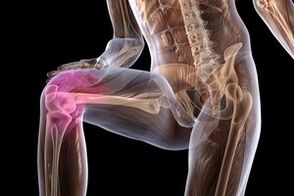
Every day our knees have to withstand body weight and physical activity.Over the years, the cartilage wears down and changes occur in the joint.It is for this reason that older people experience osteoarthritis in the knee joint.
Osteoarthritis of the knee joint (gonarthrosis) is a degenerative pathology in the joint where cartilage is destroyed, muscles and ligaments are damaged and bones are deformed.
Treatment of osteoarthritis of the knee joint at home is a certain set of actions that relieve the patient's condition.
If the treatment is supplemented with competent medical prescriptions, the development of the disease can be slowed down and sometimes completely stopped.
Symptoms and causes of osteoarthritis
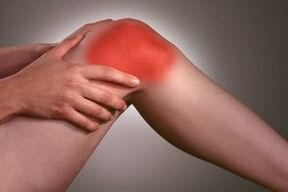
The first of the signs that indicate gonarthrosis of the knee joint is stiffness of the knee and the occurrence of pain after minor efforts, sleep and long sitting in place.If the patient warms up a little, the pain will subside.When bending the knee, a crunching sound is often heard, and after hypothermia, the pain worsens.
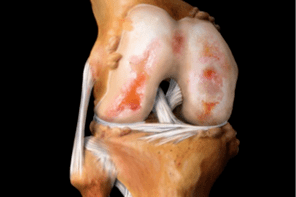
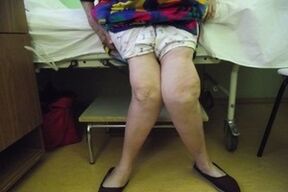
Such signs of the disease appear over several years and are sometimes disturbing.If the problem is not treated, over time it becomes difficult to walk, the knee joint becomes deformed, and it becomes impossible to move without crutches.
The following can help accelerate the development of pathology:
- Excess weight of the patient, which triples the rate of progression.
- Regular exercise.
- Meniscus injuries, fractures and knee injuries.
- Errors in bone placement (X- and O-shaped).They deform the cartilage tissue and the joint as a whole.
Stages of development of osteoarthritis of the knee joint
Stage 1
The legs become very tired, mobility begins to be limited and a crunching sensation occurs.Joint pain also occurs at rest and during prolonged exercise.At this stage of the disease, there is no deformation of the knee, and the joint gap can only narrow.
Stage 2
Deformative osteoarthritis of the knee joint, grade 2, requires immediate treatment, as the pain becomes severe and restricts movement.A person is unable to move for long distances and needs a lot of rest.With a loud crunch and deformation, lameness appears.The bone grows and osteophytes form, fluid accumulates in the case of synovitis.
Stage 3
The most difficult phase of the disease.Pain occurs even at rest, and the leg becomes almost immobile.The joint gap can disappear completely.
Who is at risk?
- people with extra pounds;
- anyone who leads a sedentary lifestyle;
- patients with knee injuries;
- professional and amateur athletes who put a lot of stress on their knees;
- people with an occupation that puts a lot of stress on their knees;
- patients with pathologies of cartilage and bone;
- people with infectious diseases and parasitic diseases.
All these reasons accelerate the development of the disease at an early age and lead to a complex course of the disease.
Treatment of osteoarthritis in the knee joint
Currently, doctors do not select a single treatment regimen, as there is no specific medication that helps patients in the same way.When planning treatment at home, doctors take into account the degree of the problem, the age of the patient, the severity of pain and the degree of joint deformation.
Therefore, it will take a long time and diligently to treat such a disease using different methods to affect the sore knee.
Principles of nutrition
Everyone should understand that it is necessary to start treating osteoarthritis at home with a dietary correction.In this case, an increase in the amount of calcium, vitamins "B" and "E" is considered a prerequisite.The body can get these elements from sprouted wheat, dairy products, almonds, whole grains, bread and pasta.
Salt should be limited and increased in vegetarian salads and vegetables after rapid heat treatment.
Anyone planning to treat osteoarthritis to any extent should exclude acidic fruits such as grapefruit, lemons, oranges, as well as alcohol and coffee from their diet.The amount of meat consumed should be minimized, as should dried fruit and grains.
Jellied meat made from bone broth is considered a healthy dish as it is enriched with collagen, which is necessary for the building of cartilage and bone material.It is equally important to use gelatin, which contains the main chondoprotectors.
Gymnastics
Even in the most advanced degree of osteoarthritis, treatment involves performing three exercises:
- You must sit on a high chair or table so that your legs hang down freely.Then they start babbling them with an amplitude of up to 10 cm.Severely ill patients are allowed to perform the exercise for 5 minutes every hour, and for other patients - 10 minutes a few times a day.
- Sit on a chair, place your feet on the floor.Leaning on the toe, the heel rises 12 cm from the floor and then falls freely.After 3 seconds, the exercise is repeated.For both sore legs, the exercise is performed alternately.
- Sit on a chair and put your feet on the floor.Then lean on your heel, relax and slowly tap your toes to the floor, raising them no more than 12 cm.Take a 3-second break between exercises.
Knee joint massage
At home, you can independently work on the knee joint with osteoarthritis using blows through the fingers, the palm of the hand and slaps.
Under the influence of spanking, the skin activates nerve pathways and causes a rush of blood.When struck through pressed fingers, the impact spreads to muscles, ligaments, tendons and the joint capsule.Thus, the blood is more easily squeezed out of the capillaries without damage.
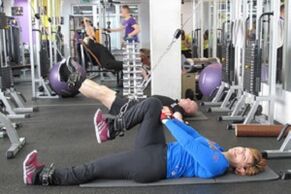
The treatment should begin by tapping with pressed fingers on painful places.The kneecap is turned from the side.Hitting a very tender joint should be done as gently as possible, and as it recovers, they should be strengthened a little.
The damaged tendons should be tapped gently and then struck with a pressed palm on the right, left, front, on the straight leg, below the knee and on the bent leg.The session ends with a beating.
Number of procedures required:
- moderate arthrosis - once a week;
- mild stage of osteoarthritis - once every 23 days;
- severe osteoarthritis with inflammation and swelling - once every six months.
Magnetotherapy
This procedure can easily be done at home and will not further deform the knee.For many years, magnetic therapy has been tested in practice and has always shown excellent results.
A knee joint affected by osteoarthritis can be treated at home under the influence of a weak magnetic field.This treatment normalizes blood circulation and metabolism.Thus, the outflow of fluids from tissues accelerates.
To treat a problem with a magnet, you do not need to perform complex actions.The procedure only requires a small magnet.Massage the area of the injured knee with circular movements for 20 minutes once a day.The duration of such treatment is usually up to three months.There are many reviews about the treatment of grade 2 osteoarthritis of the knee joint with a magnet, and they are all positive.
Thermal treatments
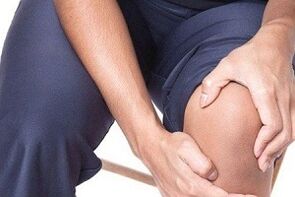
The ability to perform thermal procedures at home is limited.Instead, you can use wet and dry heat – foot baths and compresses.
Add sea salt (one spoonful per liter) to water heated to 45°C, then pour it into a tall tank so that your knees are completely immersed in it.Warm water helps dilate blood vessels, and salt removes excess fluid from the periarticular tissue.
Sand with coarse salt or a mixture of dry herbs is heated in the microwave or in a frying pan and then wrapped in thick material and cooled to room temperature to apply to the knee.After such a treatment, the compress is not thrown away - it is used for the entire course.
At the end of the thermal procedure, a gel (ointment) prescribed by the doctor is applied to the knee joint.With enlarged pores, the substance penetrates better and has a stronger analgesic effect.
Treatment with medication
At home, treatment of arthrosis of the knee joint of varying degrees of complexity can be carried out with local drugs with anti-edematous, anti-inflammatory, warming and pain-relieving effects.The advantage of these means is the possibility of long-term use.The active substance in the ointments does not penetrate in such a volume that it causes side effects.Thus, the circle of people who are available for treatment is expanded if a course of injections or tablets with the active substance is prohibited.This applies to NSAID drugs, which are prohibited for people with chronic and acute gastrointestinal diseases and other disorders of internal organs.When used topically, they provide pain relief and relieve inflammation in osteoarthritis.
Traditional recipes for the treatment of knee osteoarthritis
Amazing medicinal plants are known in nature, which are necessary for the production of collagen and the restoration of cartilage.
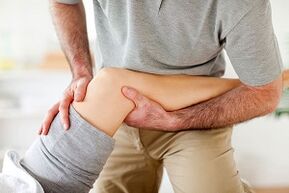
- Gelatin- a popular treatment for joints.To prepare the medicine, take a spoonful of gelatin and pour a quarter of a glass of water into it in the evening, and in the morning, when it has risen, consume it on an empty stomach.For a full therapeutic course, you need 150 g of gelatin.The drug is contraindicated for people with high blood clotting.
- Dandelion– freshly picked flowers are thoroughly washed under water and then chewed into pulp.You must eat up to 5 flowers per day.For treatment in winter, it is worth preparing the leaves of the plant.The leaves must be chewed daily despite the bitter taste.Dry grass is poured with a glass of boiling water and soaked.Dandelion tincture has an excellent effect.You must rub it on your knees for a month.The pain will quickly disappear, but the procedure must be continued.To prepare the remedy, collect many dandelion heads and fill a bottle with them, then fill it with alcohol or triple cologne.The tincture will be ready in a month.
- Honey and by-products– a unique remedy for arthrosis in the knee joint.Honey is heated with a heating pad and then applied to the affected area, rubbed in with light circular movements.The process is carried out once a day for half a month, and after a break the session is repeated again.
- Burdock– a common plant for treating joints.You need to take 6-7 burdock leaves and fold them with the soft side down.Place a pot of hot water on this stack until it cools.The knee is smeared with vegetable oil, leaves are placed on top and wrapped in polyethylene and a towel.
- Cinquefoil and cinquefoil (tincture)– cinquefoil and cinquefoil roots (2:1) are poured with vodka and left for 20 days.The finished product is taken orally, a spoonful before meals, for a month, and then take a break.The combination of herbs relieves swelling, increases joint mobility and eliminates bruising.
- Cabbage juice– this product should be soaked in woolen material and applied to the sore spot.The procedure is performed before bedtime.The finished juice is stored for no more than three days in a dark place.You can make compresses from cabbage leaves.The inside of the leaf is smeared with honey and applied to the sore knee.This is then reinforced with polyethylene and woolen cloth overnight.The compress is removed in the morning and the remaining honey is removed with warm water.The course of treatment lasts one month.
- Compress of coagulated milk with chalk– add an acidified milk product to the ground chalk, mix thoroughly and apply the mixture to the knee joint.After insulation with film and cloth, the remains are removed the next morning with a napkin.Chalk compress relieves inflammation and relieves pain.
- Therapeutic bath with pine wood– conifers are always used to treat rheumatoid arthritis and most often in the form of baths.To prepare the medicinal mixture, take pine branches with needles, a few chopped Jerusalem artichokes, 1 tsp.turpentine, 1 kg sea salt, 2 tbsp.l. honey You cannot stay in such a bathroom for a maximum of 20 minutes, and then wipe your skin with a towel.A net of iodine is drawn on the sore joint and smeared with honey.A steamed mesh of lard is also applied.The course of treatment for osteoarthritis is two weeks.
Osteoarthritis in the knee is a disease that most people often have to deal with.Therapy at home helps to stop the development of the disease, as well as completely restore the joint substance.Moreover, the effectiveness of the methods depends on the patient himself and his desire to recover.